How To Plot A Novel

When I started writing young adult books, I found this information over at CJ Omololu’s blog, and put it into the form of a chart. It helps me visually see how elements in each box should connect. This is very basically how I plot a novel. And the only kind of outline I’ve ever used. It’s been a wonderful tool for helping me pace my books events. Plot is now one of the easiest things for me to manipulate and “fix” in my books. But it used to be one of the hardest for me. So, thank you, to CJ for this tool. I hope it helps other writers, too.


PS: Please forgive the typos within the chart. I took an image of a document, and really just don’t feel like going back at this point to fix it. I’d rather go write fiction.

Must Be Santa

I found this a few days ago, hanging out in my desk. It’s from 2002. Magnolia is two yrs old. Eleanor is almost five. You can see they pretty much came out of the womb celebrating reality. What I remember from this day was that we went with some friends whose kids were of similar ages. I had to tell the girls before we left not to ruin Santa for the boys. They did a great job keeping their mouths shut. This was the only photo they ever had with Santa. It’s one of my favorites.

Why I Chose Public Schools

A little while back I had a conference with Magnolia’s principal and teacher. We got to talking about the ways in which her school program was a “magnet.” I was new to the area and new to the concept of Magnet Schools. If you are unfamiliar, I’ll give my perception but it’s not the official definition: Magnet programs adopt a special curriculum which focuses their school on a “specialty” which is aimed to attract students and families. So, Maggie’s school, as an environmental magnet, should attract people all around the city (not just a particular neighborhood) to attend the school, who are interested in any kind of “environmental studies.” So, what makes it an environmental school? It sits on 39 acres. Students have access to a planetarium. They have Partner In Education days where students get to do outdoor activities such as sledding or fishing. There’s a greenhouse, and an outdoor garden, and last year a geologist came with a fancy digger to take a very deep sample of soil, and explain the layers. Pretty nice for an elementary program. While this had a lot to do with choosing which magnet school I liked for Magnolia, it’s not why I chose the public school system.

I operate under the assumption that my kids are smart enough to succeed at most any school and that the education they receive will be good enough because they will make the most of it. So if you take the quality of curriculum out of the decision, what’s left?

When Eleanor came home and said, “I saw a pregnant teenager and heard the F-word five times,” I thought, good. That wouldn’t have happened in the middle school in Chelsea, Michigan. When Maggie’s principal said, “Some of these kids have never seen soup made and have never eaten a meal cooked from raw food,” I was like really? I thought that only happened on Jaime Oliver’s Food Revolution. One of Maggie’s classmates lives without hot water. The poverty she sees belongs to a real person – one of her friends. She also told me, “Someone on the bus asked me if I live with my mom or my dad.” I said, “What did they say when you told them you live with both?” She said, “They were like, ‘You don’t have to rub it in.'” I know she felt confused, but I think that’s good. I want her to have to think through that. I want the kids to be a part of the community in which we live, and experience the culture of Indianapolis. That’s why I chose the public school system.

A Visitor Among Residents

I feel thoughtful and a little reactionary, which probably means this post will come off as self-indulgent and uninteresting. I blame HR. Just kidding, Tracy. Sort of. When I hired in, there was no HR department. The company I work for is growing rapidly; we recently hired eight more people for the department in which I work. Pretty soon we’ll have an employee handbook, and policies are coming down the pipe faster than Drano.  What used to feel like a few people hanging out, building links (I thrived in that atmosphere), now feels like a job – a job in a Young Company with Young People. The president and partners are all younger than me.  It’s not that I feel older and wiser or anything like that. No, I’m comfortable with my leaders. Very. My issue is that I sometimes struggle with how on track everyone around me is. Their young lives going along in an orderly fashion, and I feel how differently I’ve done things. Sometimes I’m thankful for the weird turns my path has taken and sometimes I just feel behind in life – or maybe it’s more like sideways. Surely everyone, no matter their “track,” feels the same kind of dual thankfulness and insecurity about how they’re living, changing, and achieving.

Lately at work, the insecurity I’ve been feeling annoys the piss out of me. Here’s the thing(s): I’m 36 years old, in an entry level job, with aspirations to become a YA author. The “typical” employee at my company is fresh out of college, or transitioning here from a first or second job. He or she is looking to begin a career in a flashy young company, grow with it, and learn the shit out of it, and get into a position to support a nice lifestyle for self or family. And, according to new policies, this kind of employee will be rewarded for his or her investment in the company. It’s a lot like the “college-bound” kids in high school – who the classes and curriculum are designed for. But what if I’m on a different path, one that is not headed for college, so to speak? Do I still fit?

Because I’m on a different path, I don’t need that A+ grade and that citizenship certificate. I’m not motivated by it. I want to provide for my kids and husband, and I want to do a good job – because I care about the company. And I like it there. But, it is and always will be less of a priority than the other parts of my life: family and writing. This, I feel like, puts me into a non-traditional grouping (maybe a group of one person), and that leads to my insecurity. It’s not that I think I deserve a reward for having different priorities, it’s just that I see everyone else on the traditional path, and I find myself veering that way, feeling fake, and then asking myself what I’m doing. Kind of like visiting a southern state and picking up the accent. Suddenly you’re like, “Oh shit, I’m a poser. I don’t really talk like this.” And in many ways I think I’ll always be a visitor among residents in my job. I really hope so, anyway. Even if it makes me “less” of a worker and no matter the insecurity I feel. I’ll always love my family and the craft of writing more than building links. It’s a conviction as well as a decision. And, now it’s on the record.

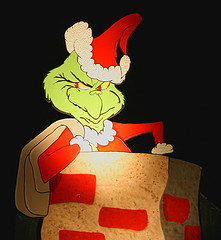
Of Grinches and Pink Christmases

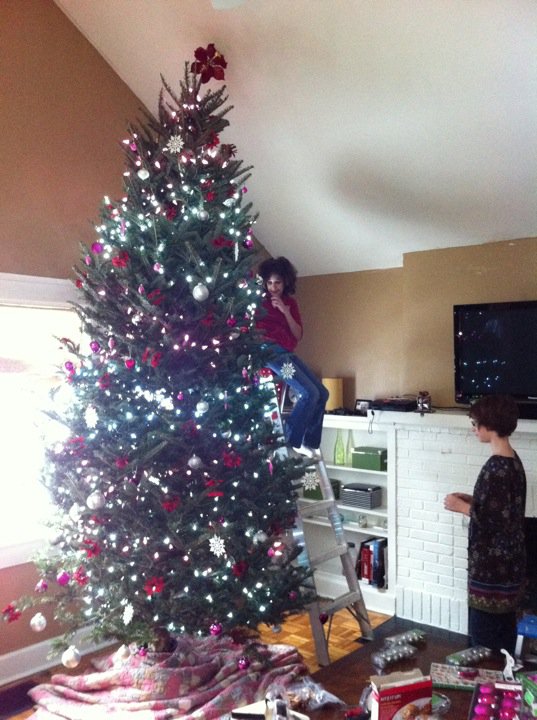
Upon moving into our house and seeing the wonder that was a vaulted ceiling, Magnolia said, “Wow, we can get a really BIG Christmas tree!” So of course I’ve been not-so-secretly looking forward to seeing her little face light up when we picked out a big one. Maggie Pie has a special relationship with Christmas since her birthday is the 28th. When she was littler, she was convinced that all the lights on houses were people celebrating her birthday. For her, LOTS of good cheer arrives during the Holiday season.

So, this year we bought the biggest tree we could. It stands 10 ft. Josh knew as he was paying for it that it was going to be obnoxious to deal with and look like we were, um…compensating. But the Christmas spirit kissed his ass, and he bought it. It only took one trip to Lowes to buy a few things to steady our tree stand, which couldn’t support our jolly green giant. And a little over an hour later, the tree was up.

That’s when I realized we couldn’t find the ornaments. Or lights. Or stockings. Or advent calender. Or any other Christmas malarkey. Those last couple of boxes I never unpacked? They did not contain Christmas. It was baffling, and truly very grinchy. So, Maggie Pie and I went to Big Lots to save Christmas. In true Maggie style, we carefully decided on a theme of Pink and White, with red poinsettias. We even bought pink, white, and silver wrapping paper. It’s all very flashy, beautiful, and bright. In fact, I have this weird urge to sing O Birthday Tree.

Book Review: Amy and Roger’s Epic Detour

I’m not a huge fan of books that are paced as slowly as this. There was nothing wrong with its pace, so the fact that I wished it would hurry along a little has virtually nothing to do with the book’s quality. I also kept thinking, I bet Morgan Matson is a fan of Sarah Dessen. Try as I may, I can’t fall in love with Dessen’s work. I’ve tried three times. Again, it has little to with quality and a lot to do with tastes. Why do I keep thinking I will love these soft romance tear-jerking books? Because I keep thinking I’m missing out on some universal emotional experience. That I SHOULD love them, since so many people do. I probably won’t stop either. I’ll probably write another review like this next month.

I told myself I wasn’t going to read any more young adult books that dealt with death for a little while. Ha! It’s hard not to. It is a perfect metaphor for coming of age. When does a teen stop “needing” parents and go off into the world alone? In this book Amy is struggling to live without her father, who died in a car accident three months prior to the book’s beginning. A road trip across America offers her all kinds of new perspectives on living. It was a well-constructed setting. One thing I loved about the main character, was her perspective on death. She didn’t give us an “everything happens for a reason” kind of point of view, and it was incredibly refreshing to follow a character who was willing to suffer the sourness of lemons, rather than insisting on making lemonade (sometimes things just suck). Amy still found hope and determination to overcome her guilt and suffering. That alone, made the book worth the read.

I took issue with the book, stylistically. Have you ever read Lynn Rae Perkins Criss Cross? Or Johnathan Saeran Foer’s Extremely Loud and Incredibly Close? Those books take on visual elements as if the character’s doodling, or typing, or conducting research in a way that doesn’t quite make the book a graphic novel. Maybe I’m unforgiving, but I haven’t yet read a book where this feels seamless and necessary to the book. I felt the same way with this book, which included song lists and photos of receipts and the like, in an effort to show Amy’s travel scrapbook as she journied along. To me, it came off a bit gimmicky. I wonder if the author had this scrapbooky feel in mind when she wrote it.

A World Made of Pink Bubble Gum

When I was a little girl I would use my birthday wishes to try and turn the world into a place where everything was made of pink bubble gum. If it eventually happens, you know who to blame. I’m not too worried though. But, I was thinking about that and comparing it to how my own daughters imagine and make wishes. Part of writing young adults books is understanding the way young people think and operate. I love thinking about how my own kids think.

My daughter Eleanor at that age once told me she wanted to grow up and live in a naked city. I told her I probably wouldn’t be coming to her place for holiday visits. Magnolia lost a tooth the other day and informed Josh she’d be putting it under her pillow for him. Every year they sleep under the Christmas tree not to wait on Santa, but to be within an arm’s reach of the presents under there when first light hits. Did they ever believe in Santa? I don’t think so. Once, Eleanor said sadly, “I wish dragons were real.” It was more of a realization that they never would be than a prayer for change.

So, I was raising realists. Was this somehow going to thwart their imaginations, I wondered. But no, I don’t think so. In fact, they have an understanding that I didn’t. They can master their wishes and imaginings on paper or during play in a way I never bothered with. They can create more completely because they know they are in control. I believed so hard in some magic force that would actually turn the world into bubble gum for me, that I think I never let my imagination play itself out and see what that world was really like. I would stop imagining when the wish was done. And then I’d wait.

I suppose this is one more reason why I’m so in love with reading and writing stories now, especially ones with teenagers, where their wishes become more about where they fit into the real world, and how their imaginations might change the course of their lives. And maybe this also why I love contemporary fiction. I LOVE the magic of real life love and suffering that makes us human.